If you’ve ever stood beneath the towering blades of a wind farm, watching them spin steadily even in unpredictable gusts, you might not think about the quiet, unassuming components working behind the scenes to keep the whole system safe and operational. As a wind power fuse supplier, I spend my days talking with farm operators, maintenance technicians, and project engineers who rarely see these small but critical parts until something goes wrong—and when it does, they quickly understand why backup fuses are non-negotiable for wind power systems. Let me break down what a backup fuse is, why it matters for wind farms, and how we design ours to stand up to the unique demands of this renewable energy sector. Wind Power Fuse
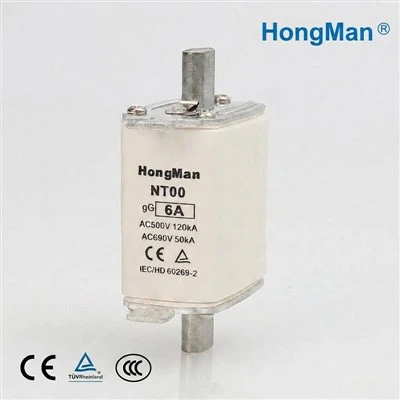
First, let’s get clear on basic fuse 101, tailored to wind power. A fuse is a simple, electromechanical safety device designed to overheat and break an electrical circuit when current running through it exceeds a safe threshold. For standard home or commercial fuses, this might mean interrupting a circuit during a power surge from a lightning strike or a faulty appliance. But wind power systems operate in far harsher, more variable environments: they’re exposed to extreme temperatures, constant vibration from spinning blades, and wide swings in electrical load that come with changing wind speeds. That’s where a backup fuse differs from a standard fuse. Unlike primary fuses, which handle routine overcurrent events, backup fuses act as a secondary safety layer. Primary fuses are sized for normal operating current and minor, predictable surges, but backup fuses are engineered to catch the rare, extreme events that a primary fuse can’t handle—events that could cause catastrophic damage to a wind turbine’s generator, power converter, or grid connection.
Let’s ground this in a real scenario that I’ve heard from dozens of customers. A wind turbine’s main power converter converts the variable alternating current (AC) generated by the spinning blades into direct current (DC) for storage, then back into AC for the grid. On a day with a sudden, unanticipated 60 mph gust, the turbine’s blades spin faster than designed, sending a spike of excess current through the system. The primary fuse kicks in, as it’s supposed to, and stops the surge. But what if that surge is even larger—say, from a direct lightning strike that hits the blade’s tip and travels down the grounding wire into the electrical cabinet? A primary fuse, which is built for everyday overcurrent, might melt too slowly, allowing that massive spike to travel through the converter, overheat the generator’s copper windings, or fry the inverter board. That’s where the backup fuse steps in: it’s placed in parallel with the primary fuse, designed to activate faster during these ultra-high, short-duration current surges that a primary fuse isn’t built to interrupt. Backup fuses for wind power are also sized to handle temporary overcurrent events that are too extreme for standard primary fuses, without triggering during normal, minor load fluctuations from light wind.
What makes wind power backup fuses different from fuses used in other industries? Let’s list the unique demands that set them apart, because that’s where our team at Wind Power Fuse has focused our design work. First, environmental durability. Wind farms are often located in remote, exposed areas—on hilltops, offshore platforms, or coastal sites where salt air and humidity are constant. A backup fuse that works in a climate-controlled factory won’t hold up to temperatures ranging from -40°F in the middle of a North Dakota winter to 120°F in the Arizona desert, or the salt spray that eats away at uncoated metal parts in the North Sea. Our backup fuses are coated with corrosion-resistant materials and rated for a wide temperature range, so they don’t degrade even after 10+ years of exposure. Second, vibration resistance. Turbines spin 24/7, creating constant mechanical vibration that can loosen connections or fatigue fuse elements. We test our backup fuses with 100 hours of continuous vibration at frequencies matching the exact output of standard turbine blades, ensuring they don’t fail from shaking during normal operation. Third, current specificity. Wind power systems have unique current profiles: variable DC from the generator, pulsed AC from the converter, and high-energy surges from lightning or grid faults. Unlike automotive fuses, which handle low-current, steady loads, our backup fuses are built to interrupt high-voltage (up to 1,500V DC) surges in microseconds—fast enough to stop a surge before it damages sensitive electronics.
I often get asked: “Why not just use a single, oversized primary fuse instead of two separate fuses?” The short answer is that it’s a bad idea, both for safety and cost. An oversized primary fuse would have a lower melt point than needed for normal operation, so it would blow during routine minor surges from wind gusts, leading to unplanned turbine downtime—something wind farm operators dread, because every minute a turbine is offline is lost revenue. Backup fuses are calibrated specifically for extreme, rare events, so they don’t interfere with normal operations. They’re also a cost-effective safety layer: replacing a backup fuse is far cheaper than replacing a turbine’s generator or power converter, which can run into hundreds of thousands of dollars. In my conversations with maintenance teams, I’ve heard horror stories of farms that skipped backup fuses to cut costs, only to lose $500,000 or more in turbine damage after a lightning strike—cost that far outweighs the price of backup fuses for an entire wind farm.
Another common misconception: backup fuses only matter for new wind turbines. That’s not true—retrofitting backup fuses to older turbines is one of our fastest-growing lines of business. Many turbines built before 2015 only had primary fuses, and as grids have become more variable (with more reliance on renewable energy and more frequent grid fluctuations), operators are realizing they need that extra safety layer. We work with farm managers to audit their existing systems, identify where backup fuses will add the most value, and retrofit them without expensive rewiring or downtime. One of our recent customers, a small wind farm in Iowa with 12 turbines, told us that before adding backup fuses, they’d had two lightning-related turbine failures in 2022, costing them over $120,000 in repairs. After installing our backup fuses in early 2023, they haven’t had a single surge-related issue.
What goes into manufacturing a reliable backup fuse for wind power? It’s not just cranking out a metal wire inside a glass tube, like a household fuse. Our team works with electrical engineers and turbine technicians to source materials that can handle the specific current and environmental conditions. We use high-purity silver for the fuse element, because it conducts electricity better than copper and resists oxidation, which is critical for long-term reliability. The housing is a high-grade ceramic that can withstand extreme heat and pressure when the fuse melts during a surge. We also add a “indicator pin” that pops out when the fuse activates, so maintenance teams can quickly spot a failed backup fuse during routine inspections—no need to take apart electrical cabinets to check each one. Every unit goes through three tests before it leaves our facility: a current test to make sure it blows at the exact rated current, a vibration test to simulate 10 years of turbine shaking, and a temperature test to ensure it works in both extreme cold and heat.
I also want to touch on a less talked-about role of backup fuses in wind power: grid stability. Wind farms feed power into the electrical grid, and when a turbine’s electrical system has an unaddressed fault, it can send unwanted power back into the grid, causing fluctuations that affect neighboring homes and businesses. Backup fuses stop that by interrupting the fault current before it can spread. In an era where grid operators are pushing for more reliable renewable energy, having properly installed backup fuses isn’t just a safety measure—it’s a way for wind farms to prove they’re a responsible, grid-compatible power source. Grid inspectors often now check for secondary safety devices like backup fuses when approving new or upgraded wind farm connections.
Now, if you’re a wind farm operator, maintenance manager, or project engineer, you might be wondering: how do I know if I need backup fuses, and what size do I need? The first step is a system audit: we can work with your team to map your turbine’s electrical system, identify the primary fuse ratings, and determine where backup fuses will provide the most protection. We offer backup fuses in a range of ratings, from 500A to 2,000A, to match different turbine models and system voltages. We also provide installation guides and support for retrofits, so you don’t have to hire outside contractors to add the fuses.

At the end of the day, wind power is all about reliability—we’re harnessing the wind to provide consistent, clean energy to millions of people, and every component in a turbine has to pull its weight. Backup fuses might be small, but they’re one of the most critical parts of that system. They’re the quiet guard that stands between a minor surge and a catastrophic failure, between lost revenue and uninterrupted power. If you’re looking to upgrade your wind turbine safety, add backup fuses to your components, or just have questions about how backup fuses work for your specific system, we’re here to help with your procurement and technical needs. Don’t wait for a surge to cause a costly failure—reach out today to discuss your wind power fuse requirements.
DC Energy Fuse Base References
- International Electrotechnical Commission, IEC 60269-4: Low-voltage fuses – Part 4: Fuses for a.c. semiconductor converters, 2018
- American Wind Energy Association, Wind Turbine Electrical Safety Best Practices, 2021
- Renewable Energy World, “Critical Safety Components for Offshore Wind Turbines”, 2022
- National Electrical Manufacturers Association, Fuse Standards for Renewable Energy Systems, 2020
Zhejiang Hongman Electric Technology Co., Ltd.
Zhejiang Hongman Electric Technology Co., Ltd. is one of the most professional wind power fuse manufacturers and suppliers in China. We have world-leading production equipment and strong manufacturing capabilities. Please feel free to wholesale bulk cheap wind power fuse from our factory. All customized products are with high quality and competitive price.
Address: 115 XinGuang Avenue,XinGuang Industrial Zone, Liushi Town, Yueqing City, Zhejiang Province. China
E-mail: mia@chinahongman.com
WebSite: http://www.cnfuse.com/
