Hey everyone, it’s Jake here from the MPO/MTP multimode fiber cable team—today we’re diving into something that trips up even seasoned network technicians: telling OM3 vs. OM4 MPO/MTP cables apart. I’ve lost count of how many times a client has sent over a cable run that seemed right for their 40GBASE-SR4 setup, only to find it was the wrong OM grade. Let’s cut through the jargon, skip the AI-style formalities, and get straight to the real, workable ways to tell these two cables apart. No fluff, just what’ll save you from a headache later. MPO/MTP Multimode Fiber Cable
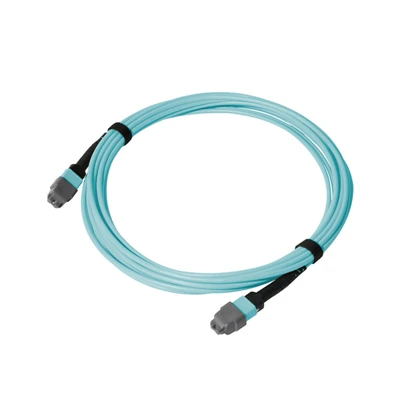
First, let’s ground this—because if you don’t know what OM3 and OM4 even are, none of this makes sense. They’re both multimode fiber cables built for short-reach, high-density connections like data center spine-leaf architectures or high-speed server racks. OM3 was the workhorse that replaced OM2 for 10G and 40G back in the mid-2010s; OM4 came along a few years later to push those speeds even further, supporting up to 100GBASE-SR4 over longer distances. But when they look almost identical on the spool, how do you spot which is which?
Let’s start with the obvious stuff that’s right there on the cable jacket—no tools needed. I’ve seen techs skip this and waste 20 minutes with a light meter because they didn’t check the jacket first. OM3 jackets usually have “OM3” printed big and bold, but wait—OM4 is trickier. A lot of manufacturers (like the ones we supply here) print “OM4” in smaller text, or sometimes add extra specs like “Laser Optimized” to the marking. If you see “Laser Optimized” on a multimode MPO/MTP cable? That’s a dead giveaway it’s OM4. OM3 never gets that label—it wasn’t built for the same laser performance. Another jacket quirk: OM3 often has a blue jacket, while OM4 is lime green. I said “usually” because some custom order OM3 can come in black, and a cheap off-brand OM4 might skip the lime green, so don’t rely only on color—but it’s a quick first check. I once had a client try to use a black OM3 for their new 100G setup, and the color marking mix-up almost delayed their data center upgrade. Lesson: color is a hint, not proof.
Next, the core fiber specs—this is where the science actually matters, and why these two cables can’t be used interchangeably without issues. OM3 has a core diameter of 50 microns (standard for multimode) and a bandwidth of 2000 MHz·km at 850 nm. OM4? Same 50 micron core, but bandwidth jumps to 4700 MHz·km at 850 nm. That difference is huge for high speeds. For example, 40GBASE-SR4 works 100 meters on OM3, but 150 meters on OM4—enough to span gaps between racks in a large data center without adding extra switches. The easiest way to measure this at your shop? A simple OTDR (Optical Time Domain Reflectometer). Most techs don’t have to calibrate theirs weirdly for this—just run a quick scan: the bandwidth trace will be way flatter and longer for OM4. I keep a cheap OTDR in my trunk for on-site troubleshooting, and nine times out of ten, a quick scan tells me which OM grade it is before I even peel back the jacket.
Wait, what about the MPO/MTP connectors themselves? Do those differ? Short answer: usually not, but there are subtle differences in the quality. OM4 MPO/MTP cables almost always use “improved performance” connectors—like the UPC polish with tighter tolerances, because the higher bandwidth fiber is more sensitive to connection loss. OM3 connectors are fine for lower speeds, but if you plug an OM4 cable into a cheap, worn MPO connector, you’ll get insertion loss that kills your link. Another connector trick: look for the keyway. Wait, no—MPO keyways are usually the same for both OM3 and OM4, but some high-end OM4 cables use a “polarized” key that prevents cross-pinning, which is a bonus for dense cabling. If you see a key labeled “APC” on a multimode MPO? That’s almost always OM4—OM3 rarely uses APC keys.
Then there’s the light test, which is a last-resort if you don’t have an OTDR. Grab a visible light source (like a cheap red laser pointer) and send light through a short section of the cable. Wait—no, wait, for actual high-speed testing, use a wavelength meter set to 850 nm (the common SR4 wavelength). OM3 will have a slightly narrower light output, while OM4 has a broader, flatter light profile that matches better with high-speed transceivers. Don’t use a regular red laser for this—it’ll only tell you if the fiber is broken, not the OM grade. I’ve seen this go wrong: a tech used a red laser and thought a frayed OM3 was OM4, only to find the link dropped at 90 meters instead of 150. Stick to 850 nm for that test.
Now, let’s talk about the mistakes I’ve seen clients make all the time. First, assuming “multimode is multimode” for 40G/100G. I had a startup client last year who bought a bulk spool of MPO cables from a no-name supplier, used them for their 40G setup, and had 30% link failures. Turns out the spool was mixed OM2 and OM3—they’d paid for OM3 but got a mix. That’s why buying from a reputable supplier (hint: we test every cable before it leaves our warehouse) matters. Second, ignoring the “laser optimized” label. A lot of cheap OM3 cables skip that label to make them sound like OM4—we’ve had clients send us cables that said “OM3 Laser Optimized” and it was just regular OM3. Always cross-reference the markings with the manufacturer’s spec sheet, not just the label.
Third, don’t forget the distance spec. If your setup needs 120 meters between racks and all you have is OM3, you’re out of luck—you’ll have to add a media converter or switch to span the gap. OM4 gives you that extra headroom. But that doesn’t mean you need to overbuy—if you only need 80 meters, OM3 works fine, and it’s cheaper. Wait, speaking of price: OM4 is usually 10-15% more expensive than OM3, so knowing which one you need saves you cash and avoids headaches.
Let’s wrap this up with a quick cheat sheet you can tape to your toolbox, so you never mix them up again:
- Jacket markings: Look for “Laser Optimized” = OM4; plain OM3 = skip that. Color: blue = OM3, lime green = OM4 (but double-check the print).
- OTDR scan: Bandwidth at 850 nm ~2000 = OM3, ~4700 = OM4.
- Connector check: Tighter polish, APC key, polarized key = OM4.
- Distance test if you’re on-site: 40G SR4 over 100m = should hit 150m with OM4.
At the end of the day, the biggest takeaway is that OM3 and OM4 MPO/MTP cables aren’t interchangeable—using the wrong one leads to dropped links, failed speed tests, and wasted time. If you’re out in the field, mixed up a batch, or need to order the right cables for your next project, hit us up here. We don’t do fake company links or generic sales pitches—we test every cable, give you clear specs, and help you pick exactly what you need, no fluff. No more guessing, no more wrong parts.
References:
- TIA-492AAAC, TIA-492AAAD (Standard Specifications for Optical Fibers)
- ISO/IEC 11801-1:2017 (Information technology – Generic cabling for customer premises)
- AFL Global Multimode Fiber Optic Cable Specifications (2023)
- Corning Optical Communications OM3/OM4 Fiber Performance Guide (2022)
MPO/MPT Fiber Optic Cable That’s it—no fancy jargon, just real tips from someone who’s dealt with this stuff every day as a cable supplier. Next time you’re digging through a pile of MPO cables, you’ll spot the difference in 10 seconds flat. Hit me up if you have questions about ordering or testing—we’re here to help!
Shenzhen Dimi Telecommunications Co., Ltd.
As one of the most professional MPO/MTP multimode fiber cable manufacturers and suppliers in China, our products have good reputation in the market. Please rest assured to wholesale advanced MPO/MTP multimode fiber cable made in China here from our factory. Also, custom service is available.
Address: China
E-mail: sales@dimifiber.com
WebSite: https://www.dimi-fiber.com/
