When it comes to specifying materials for plumbing, HVAC, and industrial piping systems, cost is only one piece of the puzzle—but it’s often the first thing that buyers want to pin down. As a CPVC fittings supplier who’s worked with residential plumbers, commercial contractors, and industrial engineers for over a decade, I’ve seen how many stakeholders fixate on upfront pricing without fully understanding the long-term value tradeoffs. That’s why so many of us end up comparing CPVC to other common piping materials like copper, PEX, and PVC, only to realize the cost story isn’t as straightforward as a per-piece number. Let’s break down the real cost of CPVC fittings relative to the alternatives, with hard data and on-the-ground insight that’s actually useful for making decisions. CPVC Fittings
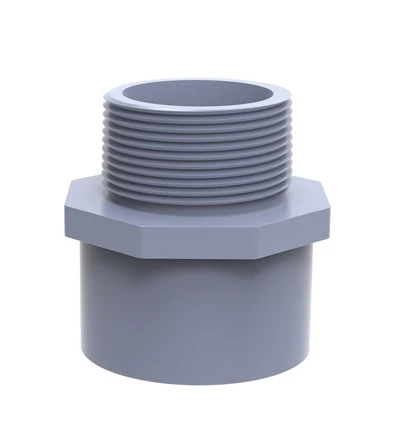
First, let’s talk about upfront material costs, the number most people look at first. When we quote CPVC fittings, the base price is almost always lower than copper and most PEX fittings, and often competitive with Schedule 40 PVC—but with a key difference. Let’s get specific: in 2024, for a standard ½-inch threaded CPVC elbow, the wholesale price is roughly $1.20 to $1.50 per piece. Compare that to a similar ½-inch copper elbow, which runs $3.00 to $4.50 depending on raw copper metal prices (which swing 10-15% every quarter based on global mining and demand). A ½-inch PEX crimp elbow clocks in at $1.80 to $2.20, a bit higher than CPVC, and Schedule 40 PVC elbows are around $0.70 to $1.00, making them marginally cheaper upfront. But here’s the catch: upfront cost only tells part of the story because CPVC and PVC are plastic, copper is metal, and PEX is a cross-linked polymer—each behaves completely differently when you factor in installation, durability, and maintenance.
Installation costs are where CPVC pulls ahead of the pack, and this is something most first-time buyers overlook. Copper requires soldering, a skill that not all plumbers have, and it comes with safety risks: improper soldering leads to leaks, and the process requires ventilation to avoid toxic fumes. That means a plumber will charge more to install copper fittings: on average, ½-inch copper piping takes 15-20 minutes of labor per joint, and in some cases, they’ll need to purchase extra flux and soldering gear, adding to the job’s total. For PEX, you need specialized crimp tools, and while the process is faster than soldering, the fittings require careful alignment to prevent leaks, especially in high-pressure systems. CPVC, by contrast, uses solvent cement to bond joints—almost any plumber can learn to do it in a 30-minute training session, and the process takes just 5-7 minutes per joint. No open flame, no fumes, no specialized tools beyond a pipe cutter and some cement. When I work with contractors, they consistently tell me that total installation costs for CPVC are 20-30% lower than copper, and 10-15% lower than PEX. For a 100-residence plumbing job, that’s thousands of dollars in labor savings right there.
But what about long-term costs, the ones that pop up after a few years or decades? This is where CPVC really stands out, especially compared to copper. Copper has one major flaw that drives up long-term costs: corrosion. In areas with acidic water (common in parts of the U.S. Southwest and Midwest), copper pipes can corrode from the inside out, leading to pinhole leaks after 5-10 years. I’ve had customers come back to me in Phoenix or Dallas saying their copper plumbing is failing, and the repair costs often run $2,000 to $5,000 per home—costs that are rarely factored into initial material quotes. CPVC, on the other hand, is inherently corrosion-resistant. It doesn’t react with acidic water, mineral deposits, or most chemicals, so it can last 50+ years with minimal maintenance. I’ve seen commercial buildings with CPVC piping installed in the 1980s that still work perfectly, no leaks, no replacements needed.
Compare that to PVC, which is often confused with CPVC. PVC is only rated for cold water applications, so if a system needs to handle hot water (like a home’s water heater lines or a commercial HVAC system), PVC can soften, warp, or leach chemicals at temperatures above 140°F. That means PVC isn’t a viable option for hot water lines, so you end up needing two different piping systems on one job—one cold, one hot. CPVC, though, is rated for hot water up to 180°F and even 200°F for short periods, so you can use the same fittings for all hot and cold water lines, simplifying inventory and reducing the risk of cross-contamination if a contractor accidentally uses the wrong fitting. For hot water applications, that means CPVC avoids the need for separate materials, which adds both cost and complexity.
PEX has its own long-term tradeoffs too. While PEX is flexible and easy to run through walls, it can degrade when exposed to UV light (so it has to be buried or installed in enclosed spaces) and can be damaged by sharp edges in framing. Some studies have also shown that PEX can leach certain chemicals when exposed to hot water over time, a concern for potable water systems. Long-term, PEX fittings can also develop leaks at the crimp rings if they’re not installed correctly, leading to water damage in walls—costs that can far outweigh the initial savings. Copper, as I mentioned, has corrosion issues, and it’s also prone to theft (a big problem in some urban areas), adding an unexpected long-term security cost that no one budgets for.
Now, let’s talk about edge cases where the cost comparison shifts. For very large industrial piping systems with pressure requirements over 150 PSI, Schedule 80 CPVC might be slightly more expensive than Schedule 40 PVC, but it’s still cheaper than equivalent Schedule 80 copper fittings. In industrial settings where piping handles corrosive chemicals (like mild acids or bases), CPVC is often the only viable plastic option, because PVC can break down when exposed to certain chemicals, and metal fittings corrode quickly—leading to more frequent replacements. In those cases, CPVC’s lower maintenance and replacement costs make it far more cost-effective than either PVC or metal, even if the upfront material price is a bit higher.
I also want to address a common misconception I hear all the time: “CPVC is less durable than metal, so it’s a false economy.” That’s true for very high-temperature, high-pressure industrial applications, but for 90% of residential and commercial plumbing, HVAC, and low-pressure industrial systems, CPVC’s durability is more than sufficient. In fact, I’ve had customers who switched from copper to CPVC report zero leaks in 10 years, while their copper systems had two or three repairs in that same period. The upfront difference is often paid back in 2-3 years through lower installation and maintenance costs, and then you get decades of no additional costs.
Another point to consider is inventory and supply chain stability. Over the past decade, raw copper prices have been extremely volatile, with jumps of 30% or more in a single year due to global demand, trade tariffs, or mining disruptions. PEX relies on petroleum-based resins, which are also subject to price swings. CPVC, meanwhile, uses a mix of PVC and chlorination additives, which are more stable in the supply chain. That means when you order CPVC fittings, you can lock in a price and avoid the weekly price fluctuations that come with metal or PEX. For contractors who need to bid jobs accurately and avoid cost overruns, that’s a huge financial benefit.
So, to wrap up: the upfront cost of CPVC fittings is slightly higher than PVC, but lower than copper and PEX. But when you account for installation savings, long-term durability, reduced maintenance, and supply chain stability, CPVC often ends up being the most cost-effective choice for most applications—residential plumbing, commercial HVAC, industrial piping for mild chemicals, and more. It’s not the cheapest upfront, but it’s one of the cheapest over the life of the system, and that’s what really matters when you’re budgeting for a project.

If you’re working on a plumbing, HVAC, or industrial piping project and want to get a customized quote, talk through your specific application, or compare costs side by side, reach out to my team to connect for a procurement conversation. We can walk through the details of your project, share real-world case studies from similar jobs, and help you find the right fittings that fit your budget and needs.
Plastic Pipes References
- International Code Council. (2021). Plumbing and Mechanical Codes for Thermoplastic Piping Systems.
- Copper Development Association. (2023). Long-Term Corrosion Performance of Copper Plumbing.
- National Association of Home Builders. (2022). Cost Comparison of Residential Piping Materials.
- Plastics Industry Association. (2023). CPVC for Potable Water and Hot Water Applications.
- PEX Equipment Suppliers Association. (2021). Installation and Long-Term Performance of Cross-Linked Polyethylene Piping.
Xiamen Sanideng Plastics Industry Co., Ltd.
Xiamen Sanideng Plastics Industry Co., Ltd. is well-known as one of the leading cpvc fittings manufacturers and suppliers in China. Please feel free to buy or wholesale high quality cpvc fittings for sale here from our factory. For price consultation, contact us.
Address: No.169, Tong Hong Road, Tong’an District, Xiamen, China
E-mail: Sandy@sanking.cn
WebSite: https://www.sankingvalve.com/
